
The importance of charge compensation in the membrane
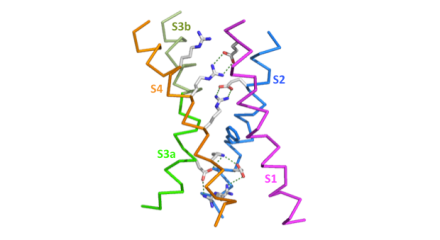
In this post I continue my series on the omega current by discussing how a mutation that removes a charged group from the voltage-sensor domain (VSD) would be highly destabilizing and disruptive. The omega current is a leak current that passes through the VSD of mutated voltage-gated cation channels. In some cases, the mutated channels … Continue reading
Omega Current Channelopathies

In this post I will be continuing my series on the omega current. The omega current is a leak current that passes through the voltage-sensor domain (VSD) of mutated voltage-gated cation channels. Mutation of the VSD S4 helix can reveal a cryptic pore that allows ions (H+, Li+, K+, Rb+ and even guanidinium) to cross … Continue reading
The Omega Current

Mutation of voltage-sensor domains (VSDs) can sometimes lead to ions leaking across the membrane through the VSDs themselves. Ion conduction through the mutated VSD of the Shaker Kv channel was coined the “omega current” by Tombola, Pathak and Isacoff (Tombola et al., 2005). Many different mutations have been identified that result in current leaking through the VSDs of … Continue reading
Pores and Selectivity Filters

In this post I will be briefly introducing the classical ideas of ion conduction through membrane proteins. The idea of ion channels as selective pores in the cell membrane is very old but is now understood at atomic detail. So what is a channel? What does an ion conductive pore look like? Here, I will … Continue reading
Biochemical Data Constraining the S4 of Hv

In this post I will finish my series on alignments and homology models. Here, I will discuss three different biochemical studies of the voltage-gated proton channel (Hv) that help to delineate the boundaries of the S4 helix. First, I will discuss the structure of the coiled-coil, which limits where along the primary the sequence of … Continue reading
Is the S4 helix of Hv Short?

In this post, I will elaborate upon a statement I made in last week’s post. There, I discussed how important a proper alignment of the S4 helices in voltage sensor domains (VSDs) is for building accurate homology-based structural models of these domains. When discussing the potential alignments I stated that “since the different conformations of … Continue reading
The Problem of Aligning S4

Recently, a number of papers have come out that have used sequence homology to generate structural models of human Hv1 (Musset et al,. 2010; Ramsey et al., 2010; Wood et al., 2012). These models have then been used for docking and molecular-dynamics simulations to try to extract some mechanistic insight into the channel function. In … Continue reading
 LettsScience